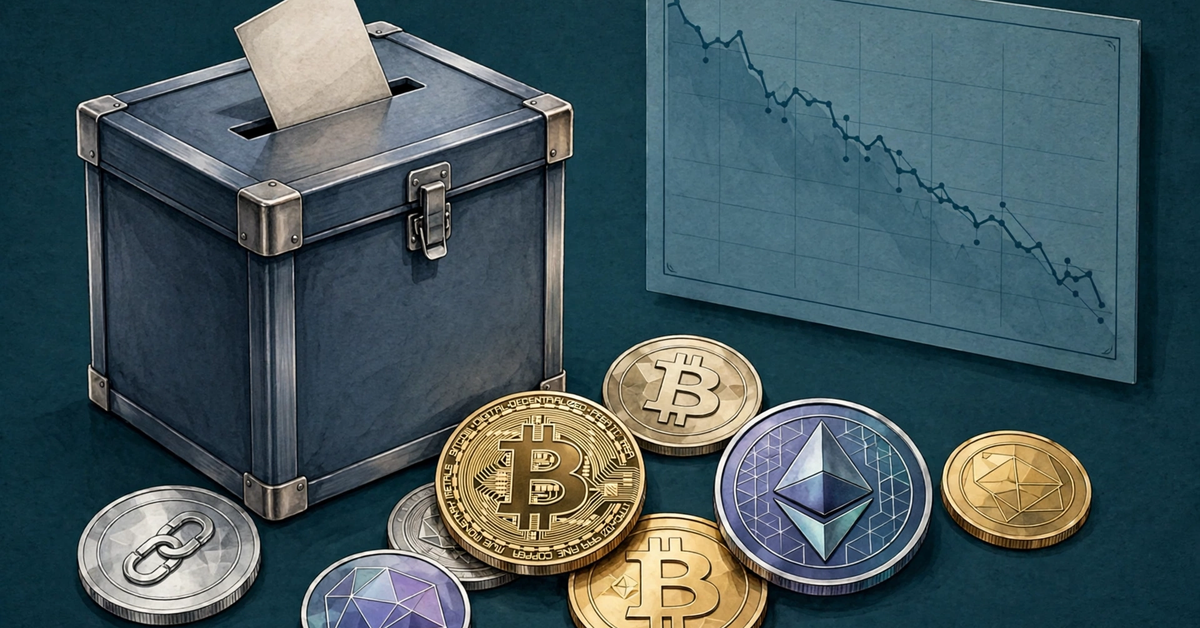
You staked at 8%, checked your rewards a few weeks later, and the rate is now 5%. Your validator did nothing wrong, and your coins did not move: a governance vote changed the reward rate, and your yield changed with it.
On many proof-of-stake chains, token holders vote on the emission schedule. When a proposal passes, the network pays out at the new rate from the next epoch or upgrade onward. Stop projecting at the old rate, rerun the math at the new rate, and judge whether the position still earns its place.
What Actually Changes When a Vote Passes
A vote does not rewrite your past rewards: what you already earned stays yours, subject to lock-up rules. What changes is the rate applied to future blocks, and therefore how your balance compounds.
The rate, not your stake
Think of it as a pay cut, not a balance cut: you still hold the same number of tokens after the vote. Only the reward percentage moves, so the damage is gradual — and measurable.
When the new rate takes effect
Timing varies: some chains apply the change at the next epoch, others at a scheduled upgrade. Check the proposal text, not just the headline result — the effective date decides which current-period rewards use the old rate and which use the new one.
The $10,000 Math: Before and After the Cut
Assume annual compounding and no price movement, so the rate change is the only variable. You stake $10,000. Year one pays 8%, taking your balance to $10,800. Then a vote cuts the rate to 5% from year two onward. Year two gives $10,800 × 1.05 = $11,340, and year three gives $11,340 × 1.05 = $11,907.
Had the rate stayed at 8%, year two would reach $11,664 and year three $12,597.12. The three-year gap is $12,597.12 − $11,907.00 = $690.12: the cut scenario returns +19.07% over three years, against +25.97% unchanged.
| End of year | Cut to 5% (year 2 onward) | Stays at 8% |
|---|---|---|
| Year 1 (8%) | $10,800.00 | $10,800.00 |
| Year 2 | $11,340.00 | $11,664.00 |
| Year 3 | $11,907.00 | $12,597.12 |
| 3-year return | +19.07% | +25.97% |
That $690.12 gap scales with your position — a $50,000 stake faces roughly five times it — and it widens over time, because the missing rewards would themselves have earned rewards.
Key takeaway: a rate cut does not touch what you already earned, but it compounds against you, so rerun your projection at the new rate instead of annualising the old one.
How to Check a Proposal Before You Vote
Most stakers only learn about a rate change after it passes. A few minutes of reading beforehand prevents that surprise, and shows whether the cut is a one-off or the start of a longer glide path.
Read the proposal, not the summary
Open the proposal on the chain's governance page and look for four things: the proposed rate, the effective date, whether it is permanent or time-limited, and the stated reason. A credible proposal names the exact parameter changed and its expected effect on issuance.
Compare the new rate with inflation
A headline APY means little on its own. If the rate falls from 8% to 5% but issuance falls further, your real yield — what you gain after dilution — may barely move. That check is covered in detail in staking APY versus token inflation and real yield, and it separates a genuinely worse deal from a healthier one.
Should You Unstake, Switch, or Stay?
A lower rate is a reason to re-evaluate, not an automatic reason to leave. Before you move, price the exit: many chains lock your tokens for days or weeks after you unstake, during which you earn nothing and cannot sell if the price drops. Add unstaking and restaking fees, and note a higher rate elsewhere may carry higher inflation or weaker security. For a related worked example, see how emission cuts change your staking APY.
There is also a case for staying. Every reward token is a new token entering supply, so cutting the rate slows dilution and can support the token's value. That only helps if the chain has genuine demand and validator numbers hold steady; a sharp exodus suggests the rate was cut too far. For background on this issuance-security-yield trade-off, the official Ethereum staking documentation is a useful reference.
Key takeaway: count the unbonding wait, the fees, and the new chain's inflation before you leave — a 5% rate you understand can beat a higher rate that costs more to reach.
Conclusion
A vote that cuts rewards is not a reason to panic, but it is a reason to recalculate. Past rewards stand, future rewards compound at the new rate, and the gap grows yearly: $690.12 on $10,000 over three years, +19.07% versus +25.97%.
Run your own numbers first: plug your stake, the old rate, and the new rate into the crypto staking calculator and compare the scenarios side by side, including any unbonding wait if you are thinking of moving.
Check proposals before they pass, price the full cost of leaving, and judge a lower rate against inflation, not the old headline alone. Then the next vote changes your spreadsheet, not your plans.
This article is for educational purposes only and is not financial advice. Staking involves risks, including lock-up periods, validator penalties, and price volatility. Do your own research before staking, unstaking, or switching validators or networks.