Staking a Deflationary Token: How Token Burns Change Your Real Yield
A staking reward quoted as 8% APY sounds simple: you lock your tokens, the network pays you more, and a year later you hold 8% more. On a deflationary token, though, that is only half of the story.
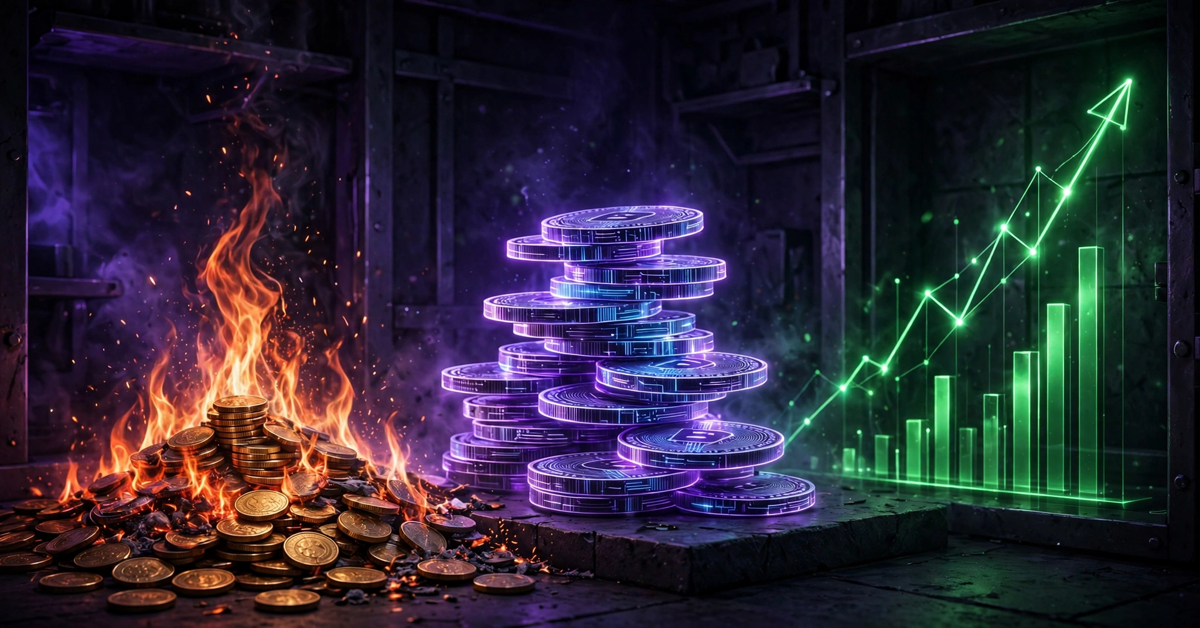
Deflationary tokens burn part of their supply on a regular schedule, permanently removing tokens from circulation. If demand stays the same while supply shrinks, each remaining token should be worth more — so your real return has two moving parts: the extra tokens you earn, and the change in what each token is worth.
What "Deflationary" Actually Means for a Staker
A token is deflationary when its total supply falls over time. The usual mechanism is a burn: a portion of transaction fees, or a fixed share of each transfer, is sent to an address nobody controls, and those tokens are gone for good. Ethereum's fee-burning mechanism, introduced with EIP-1559, is the best-known example — part of every transaction fee is destroyed, which is why Ethereum's EIP-1559 upgrade is still the reference case for burn economics.
But a burn rate on its own tells you very little. What matters is the burn rate relative to new issuance: a chain that burns 5% of supply per year while issuing 8% in staking rewards is still inflating overall, while one that burns 5% and issues only 3% is genuinely shrinking.
Key takeaway: A token is only deflationary for your purposes if burns exceed new issuance, and only sustainably so if the burns are paid for by real network usage.
The Burn Math: Yield Plus Price Effect
Your total return is the product of two factors, not a sum you can add casually: your token balance grows by the staking yield, and the price per token moves with supply, demand, and sentiment.
Here is the worked example. You buy 10,000 tokens at $1.00 each — a $10,000 starting position. The chain pays 8% APY and burns 5% of total supply per year, so after one year your balance is 10,000 × 1.08 = 10,800 tokens. What they are worth depends entirely on the price: the two effects multiply, and the price effect is never guaranteed.
Three Scenarios, One Stake
The table below runs the same stake — 10,000 tokens at $1.00, 8% APY, one year — under three assumptions about what the 5% annual burn does to the price.
| Scenario | Token price after 1 year | Tokens held | Portfolio value | Total return |
|---|---|---|---|---|
| (a) Burn has no price effect | $1.00 | 10,800 | $10,800 | +8.0% |
| (b) Burn lifts price 5% | $1.05 | 10,800 | $11,340 | +13.4% |
| (c) Burn lifts price 10% | $1.10 | 10,800 | $11,880 | +18.8% |
Working through the numbers: in scenario (a), 10,800 × $1.00 = $10,800, a gain of $800 on $10,000 — exactly the 8% yield. In scenario (b), 10,800 × $1.05 = $11,340, a gain of $1,340, or 13.4%. In scenario (c), 10,800 × $1.10 = $11,880, a gain of $1,880, or 18.8%.
When Burns Don't Save You
Now the counter-scenario, because this is where most stakers get hurt. Suppose the burn happens exactly as promised — 5% of supply destroyed — but demand falls and the market does not care. Your token falls 10% to $0.90 despite the burn.
The maths is unforgiving: 10,800 tokens × $0.90 = $9,720. You earned 800 extra tokens and still lost $280, a total return of −2.8%. The yield did not save you; it only softened a loss that would have been −10% without staking. A burn is a supply mechanism, not a price guarantee. Check the unbonding period too: a locked stake cannot exit while the price falls, and the same logic applies when a validator raises its commission mid-stake.
How to Judge a Deflationary Staking Token
Check three things before staking a deflationary token. First, compare the yearly burn rate with the yearly issuance rate — if issuance is higher, the token is inflationary in practice; check the project's documentation and CoinGecko's Ethereum page. Second, a burn helps all holders equally, so do not pay a premium in lock-up time or commission for a benefit you would get just by holding. Third, model the three cases in the table above; if the stake only works when the price rises, it is a speculation.
Key takeaway: Judge a deflationary stake on its total return — yield times price effect — and only commit if the numbers still work when the burn does nothing for the price.
Try it yourself: Run your own burn scenarios with our free crypto staking calculator — enter your stake, the APY, and different price outcomes to see your real return before you lock anything up.
Conclusion
Staking a deflationary token can genuinely pay you twice: once in extra tokens, and again if the burn supports the price. On our worked example, that second effect was worth anywhere from nothing to more than ten extra percentage points.
Verify that burns exceed issuance, confirm the burn is funded by real usage, model the downside as carefully as the upside, and never let a headline APY do your thinking for you.
Disclaimer: This article is for educational purposes only and does not constitute financial advice. Cryptocurrency staking involves risk, including the possible loss of your investment. Always do your own research (DYOR) and consider speaking to a qualified financial adviser before staking.