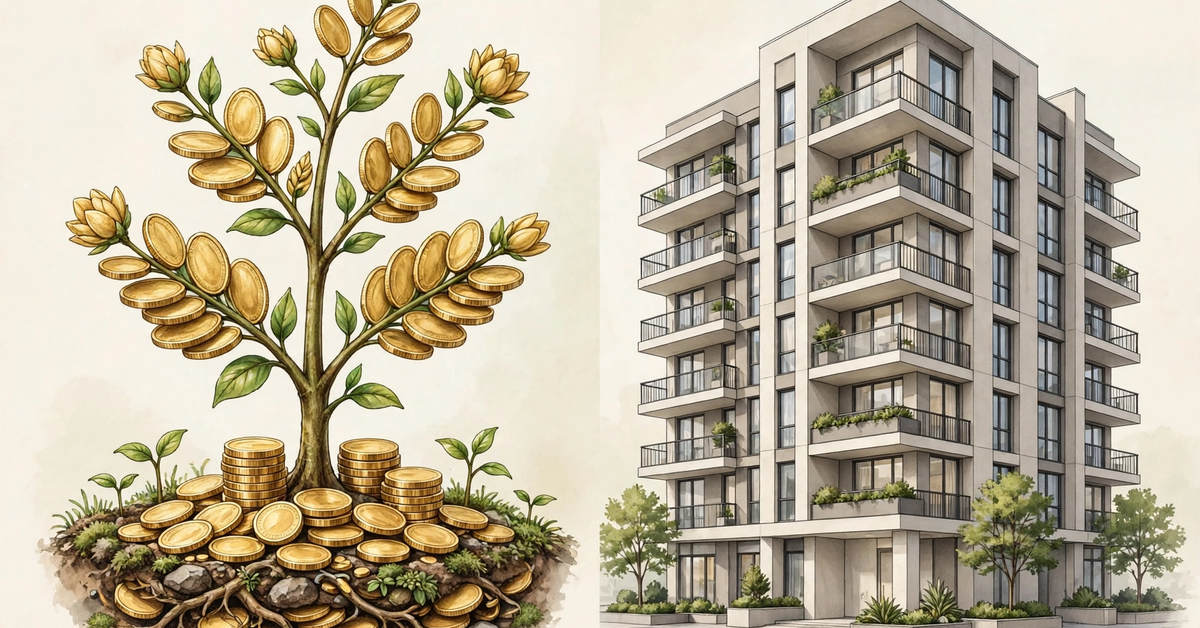
Staking Yield vs a REIT: Which Passive Income Actually Pays More on $10,000?
You have $10,000 to put to work. Two options keep showing up: stake a cryptocurrency like Solana and collect yield, or buy shares of a real estate investment trust and collect dividends. Both pay you to hold — but the money, and the risk behind it, could hardly be more different.
So which one actually pays more? The honest answer depends on what SOL's price does over the next year: staking yield is paid in a volatile asset, a REIT dividend in dollars. Run the numbers, though, and it gets surprisingly close.
How Each Investment Works
Staking SOL
Staking Solana means locking SOL with a validator to earn new SOL as rewards. The headline rate is around 7% a year, but nobody keeps it: validators take a commission — 5% is typical — so your net yield lands at 6.65%. Rewards arrive in SOL, so their dollar value moves daily. That is the trade: a high yield paid in an asset that can fall 20% in a month.
Buying a REIT
A real estate investment trust owns income-producing property — apartments, offices, warehouses — and must pay out most of its income as dividends. A typical yield today is around 4.5%, and the share price can also rise with rents and property values; 3% a year is a reasonable assumption. Income arrives in dollars, and a REIT share is far steadier than any cryptocurrency. The Nareit guide explains the structure in plain language.
The 1-Year Math on $10,000
Start simple: SOL's price stays flat for a year. Your $10,000 buys SOL, you stake it, and the 6.65% net yield adds $665.00 of new SOL. You end the year with $10,665.00 — a 6.65% gain.
The REIT does better in that flat year. A 4.5% dividend is $450.00, and 3% price growth adds $300.00 — $750.00 total, leaving you with $10,750.00, a 7.50% gain. In a year when crypto goes nowhere, the property trust wins by $85.00. Staking's headline yield is higher, but the REIT's total return wins once growth is counted.
Key takeaway: In a flat year for SOL, the REIT beats staking's net yield by $85.00 on $10,000.
What Happens If SOL Moves
SOL almost never sits flat for a year. Your staking return is two numbers multiplied: the yield plus the price move of the coin. A 20% fall wipes out the yield several times over; a 20% rise turns it into the best return on this page.
| SOL price in 1 year | Staking | REIT |
|---|---|---|
| SOL -20% | $8,532.00 | $10,750.00 |
| SOL flat | $10,665.00 | $10,750.00 |
| SOL +20% | $12,798.00 | $10,750.00 |
| 3-year compounding | $12,130.61 | $12,422.97 |
If SOL drops 20%, staking leaves you with $8,532.00 — the REIT ahead by $2,218.00. If SOL rises 20%, staking jumps to $12,798.00 and leads by $2,048.00. And the break-even is small: SOL only needs to rise 0.80% over the year to match the REIT's $10,750.00. For a zero-risk comparison, see our staking yield vs a high-yield savings account breakdown.
The 3-Year Picture
Stretch it to three years and the story barely changes. Reinvesting rewards each year, $10,000 of staking grows to $12,130.61 at 6.65% compounded. The REIT, compounding its 4.5% dividend and 3% growth, reaches $12,422.97 — still ahead by $292.36. Time does not rescue staking when the coin price is flat: the yield gap is too small.
Key takeaway: Over three flat years, the REIT still leads by $292.36 — compounding helps both sides, so the gap survives.
After Tax, the Gap Shrinks
Taxes narrow the gap but do not change the winner. Assume 22% income tax on staking rewards and REIT dividends, and 15% capital gains on the REIT's price growth. After one year, staking keeps $10,518.70 and the REIT keeps $10,606.00 — the REIT still leads, but only by $87.30 after tax, almost exactly the $85.00 pre-tax gap, because both incomes are taxed at the same 22% rate. The real difference: the REIT's growth slice is taxed at 15%, while every staking dollar is ordinary income. We ran the same head-to-head against dividend stocks with a similar result. Check SOL's live price on CoinGecko against that 0.80% break-even line.
Conclusion
If SOL's price is flat or falling, the REIT wins — by $85.00 after one year and $292.36 after three. If SOL rises more than 0.80%, staking wins — and a strong year wins by a lot. That is the real decision: the REIT pays for patience, staking pays for being right about SOL's price. Neither is free money. The REIT's risk is slow — falling rents, rising rates, a property downturn. Staking's risk is fast — a 20% drawdown erases three years of yield in a month. Choose the risk you can live with — and let the math, not the headline yield, decide.
Want to see what staking would pay on your own amount? Run the numbers with our crypto staking calculator — enter your SOL, the APY, and the validator commission.
Disclaimer: This article is for educational purposes only and is not financial advice. Crypto prices and staking yields can change quickly, REIT dividends are not guaranteed, and past returns do not predict future results. Do your own research (DYOR) and talk to a qualified financial adviser first.


