Put $10,000 into crypto and you have two classic ways to earn from it: stake coins and collect yield, or buy a mining rig and earn block rewards. Both sound simple on paper, but the returns, costs, and risks look very different once you run the numbers.
The staking leg uses Solana at a 7% annual yield, and the mining leg uses a Bitcoin ASIC rig. Prices are held flat, then tested with a 20% rise and a 20% fall. The mining figures here are illustrative: your real revenue depends on the coin you mine, the network difficulty, and your electricity price.
The staking side of the trade
Staking is the simpler of the two. You lock $10,000 of SOL with a validator and earn rewards for helping secure the network. At a 7% annual yield the gross return looks clean, but the validator's commission comes straight out of your yield.
With a 5% validator commission, the net yield is 6.65%. After one year, the $10,000 stake is worth $10,665.00, a gain of $665.00, or 6.65%. Left to compound for three years at the same rate, it grows to $12,130.61. No running costs, no electricity bill, no hardware to maintain. Pick your validator carefully: high commission or poor uptime eats into your return. The official Solana staking guide explains how delegation works.
Key takeaway: staking turns $10,000 into $10,665.00 after one year at a 6.65% net yield, with no running costs and almost no effort beyond picking a good validator.
The mining side of the trade
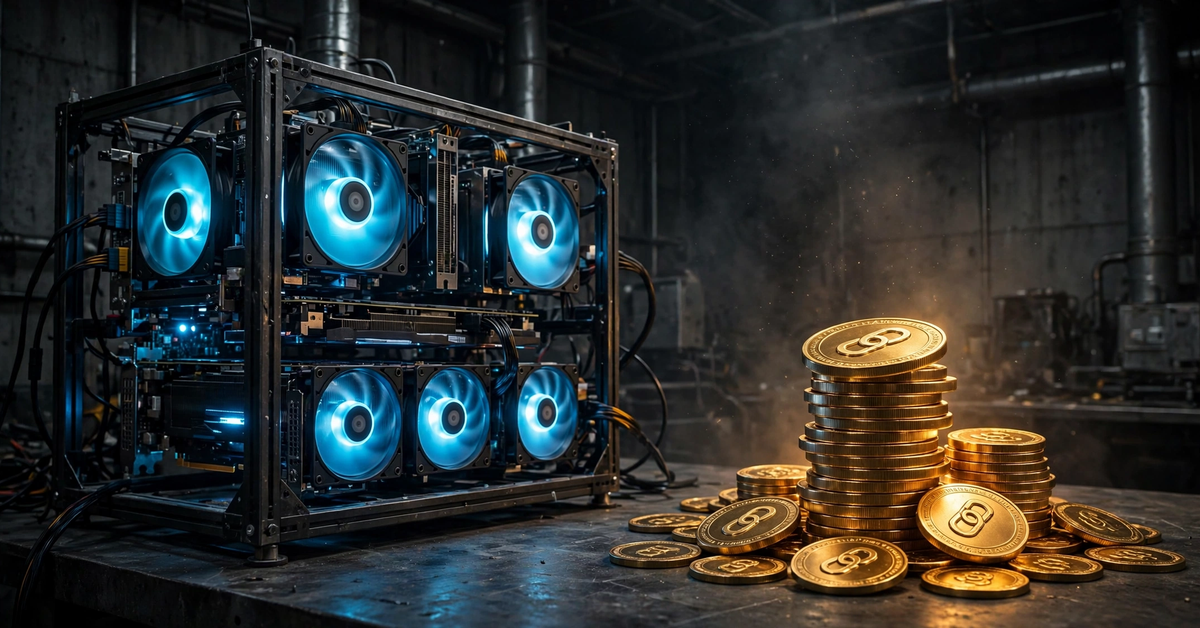
Mining starts with hardware: the $10,000 is split into a $7,500 ASIC rig running at 150 TH/s and a $2,500 cash reserve. The rig earns gross revenue but burns electricity around the clock.
At a flat Bitcoin price, the rig earns $20 per day in gross revenue. Electricity is the big cost: the rig draws 3.5 kW around the clock at $0.10 per kWh, which works out to $8.40 per day. That leaves a net of $11.60 per day, or $4,234 in cash over the year, on $7,300 of gross revenue and $3,066 of electricity.
Cash profit is only half the story. Mining hardware loses value fast: an ASIC typically loses around 40% of its value in the first year, so the $7,500 rig is worth $4,500 after twelve months, a loss of $3,000. Subtract that depreciation and the mining net is $4,234 minus $3,000, which is $1,234, or 12.34% on the $10,000, the figure most mining calculators leave out.
What happens when the price moves
If Bitcoin rises 20%, daily revenue climbs to $24, net profit becomes $15.60 per day, and yearly cash reaches $5,694. If Bitcoin falls 20%, revenue drops to $16 per day, net profit falls to $7.60 per day, and yearly cash is $2,774. After the same $3,000 of depreciation, the falling-price case leaves a net of minus $226. Electricity does not fall with the price, which is why a down market hurts miners fast. You can follow the price on CoinGecko's Bitcoin page. Network difficulty also rises over time as more miners join, so a rig earning $20 a day today may earn less in six months at the same price.
The numbers after one year
| Scenario | Staking total after 1 year | Mining total after 1 year | Winner |
|---|---|---|---|
| Flat price | $10,665.00 (+6.65%) | $11,234.00 (+12.34%) | Mining |
| BTC +20% | $12,798.00 (+27.98%) | $12,694.00 (+26.94%) | Staking |
| BTC −20% | $8,532.00 (−14.68%) | $9,774.00 (−2.26%) | Mining |
At a flat price, mining wins: $11,234.00 against staking's $10,665.00. When Bitcoin rises 20%, staking edges ahead, $12,798.00 against $12,694.00, because the full stake compounds with the price. When Bitcoin falls 20%, mining holds up far better at $9,774.00 against staking's $8,532.00, because revenue falls only 20% while electricity stays fixed and the rig keeps residual value.
Key takeaway: mining wins at a flat or falling price, staking wins when the price rises, and the gap is small in every case.
The parts the math does not show
Returns are only part of the decision. Mining needs space, tolerance for noise and heat, and hands-on upkeep: a rig runs loud and hot, needs ventilation, and needs someone to watch it. Staking needs only a wallet and a validator choice. Both carry price risk and can lose money in a bad year. Mining adds hardware, electricity-price, and difficulty risk; staking adds validator risk and, on some networks, lock-up periods where you cannot sell quickly. For context, see our comparisons of staking yield versus a high-yield savings account and staking yield versus dividend stocks.
Conclusion
On $10,000 over one year, mining pays more at a flat price, $11,234.00 against $10,665.00, and it protects your capital better when prices fall. Staking pays more when prices rise, with no noise, no heat, and no hardware to look after. Neither is a clear winner: it comes down to your electricity price, your tolerance for running hardware, and your view on the market. Before you commit real money, run your own numbers with your actual yield, electricity rate, and rig cost. You can try our free crypto staking calculator to model different stake sizes and yields.
Disclaimer: This article is for educational purposes only and is not financial advice. Cryptocurrency staking and mining both involve risk, including the possible loss of your capital. Always do your own research and consider speaking to a qualified financial adviser before investing.