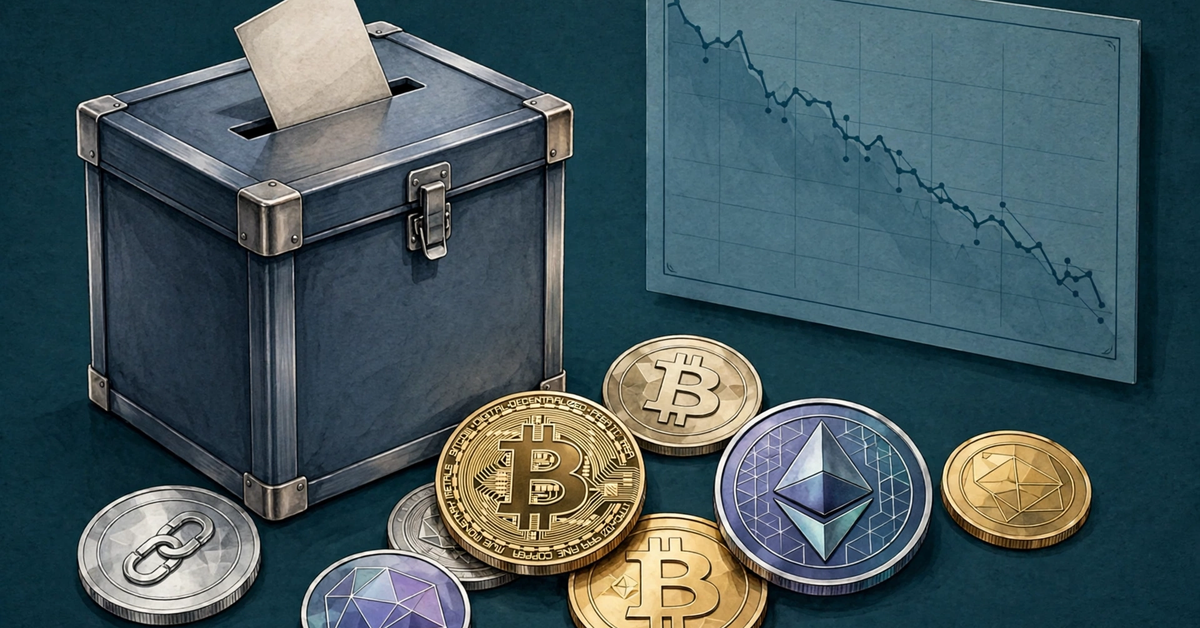
A new chain launches, and its staking page flashes a hard-to-ignore number: 40% APY, sometimes far more. For a few weeks that rate often holds — at least in token terms. Then more validators arrive, emissions get trimmed, and the headline rate slides. By year-end, the same position may earn less than an established chain.
That slide is not bad luck. Rewards come from a fixed emission schedule, and as more tokens get staked, the same pie is split among more people. The day-one APY is a snapshot, not a promise — model the decline instead of multiplying the launch rate by twelve months.
This guide shows you how, using a realistic falling-APY path, so you can compare a new chain with a steady one on equal footing.
Why Launch APYs Almost Always Fall
Early chains need stakers. Without them, the network is insecure, so protocols pay generously to attract capital quickly. Those incentives are designed to taper: emission schedules step down, validator sets expand, and total value staked rises as confidence grows. Each force pushes the rate per staker down.
There is a quieter effect too. A high APY in a chain's native token says nothing about what that token will be worth when you sell it. If the token falls 30% while you earn 20% in rewards, you are behind in dollar terms.
Three forces that compress the rate
Dilution (more stakers sharing the same pool), scheduled emission cuts, and selling pressure from newly minted rewards. None of this means avoiding new chains — it means discounting the launch rate before you commit.
Key takeaway: A launch APY is a starting point, not a forecast — model it falling by half or more in the first year before you compare it with anything else.
The Math: Quarterly Steps Beat a Single Annual Rate
Break the year into quarters and apply a different rate to each one. Assume rewards compound quarterly — each quarter's rewards join your staked balance — and keep the token price fixed for now, so you can see the yield effect alone.
Take $10,000 staked on a new chain whose APY falls from 40% to 20%, then 12%, then 8%, against $10,000 on an established chain paying a flat 8% all year:
| Quarter | New chain APY | New chain reward | New chain balance | Established chain reward (flat 8%) | Established chain balance |
|---|---|---|---|---|---|
| Q1 | 40% | $1,000.00 | $11,000.00 | $200.00 | $10,200.00 |
| Q2 | 20% | $550.00 | $11,550.00 | $204.00 | $10,404.00 |
| Q3 | 12% | $346.50 | $11,896.50 | $208.08 | $10,612.08 |
| Q4 | 8% | $237.93 | $12,134.43 | $212.24 | $10,824.32 |
| Total | — | $2,134.43 | $12,134.43 | $824.32 | $10,824.32 |
Even after the collapse, the new chain wins year one: $2,134.43 against $824.32 (21.34% vs 8.24% effective, with compounding). But almost half its rewards arrive in Q1, and by Q4 both chains pay nearly the same rate. Arrive in Q3 and your year looks very different — the trap of annualising a launch rate you missed. After an emission cut, the new rate matters far more than the old one, as explained in how emission cuts change your staking APY math.
Adjusting for Token Price and Lock-Ups
Rerun the table in token terms, then convert the final balance at a conservative price — say 20% below today's — and see whether it still beats the established chain. If it only wins when the price rises, you are making a price bet, not a yield decision. For how inflation eats into headline rates, see staking APY vs token inflation and real yield math.
Three questions before you stake a new chain
When is the next emission cut, and what rate follows it? How long are you locked, and can you exit if the rate collapses faster than expected? What share of supply is already staked — a low share means much more dilution ahead. If you cannot answer all three from the project's docs, you are guessing, not calculating. CoinGecko's Ethereum page shows what transparent, mature staking data looks like.
Key takeaway: Judge an early chain on its post-cut rate and a conservative token price, not its launch APY — if it still wins on those numbers, the opportunity is real.
Running Your Own Numbers
Pick your stake, split the year into the periods where rates will change, apply each rate to the running balance, and add the rewards as you go. The discipline is choosing honest later rates, not optimistic ones. For several coins, apply the same method to each position first; see how to calculate a blended APR of a multi-coin staking portfolio. If the new chain only wins in Q1 and then trails, wait for the rate to settle — or stake less until it does.
Use the free staking calculator on the Crypto Staking Calculator homepage to plug in your own stake, APY, and compounding period and see your projected rewards instantly.
Conclusion
Early-chain staking can pay well, but the launch APY is the least reliable number on the page. Break the year into steps, let the rate fall as it usually does, compound each period's rewards, and stress-test against a lower token price. Then a collapsing APY becomes a line in your calculation, not a surprise.
Disclaimer: This article is for educational purposes only and is not financial advice. Staking involves risks, including token price volatility, lock-up periods, and protocol changes. Always do your own research (DYOR) and consider your own circumstances before staking any cryptocurrency.