Fixed vs. Variable Staking APY: Understanding Rate Fluctuations
Staking a coin for a “10% APY” sounds simple, until the rate changes three weeks later. Understanding fixed vs. variable staking APY is the difference between a pleasant surprise and a confusing one.

This article breaks down why rates move, what drives each type, and how to plan around it.
What Fixed and Variable APY Actually Mean
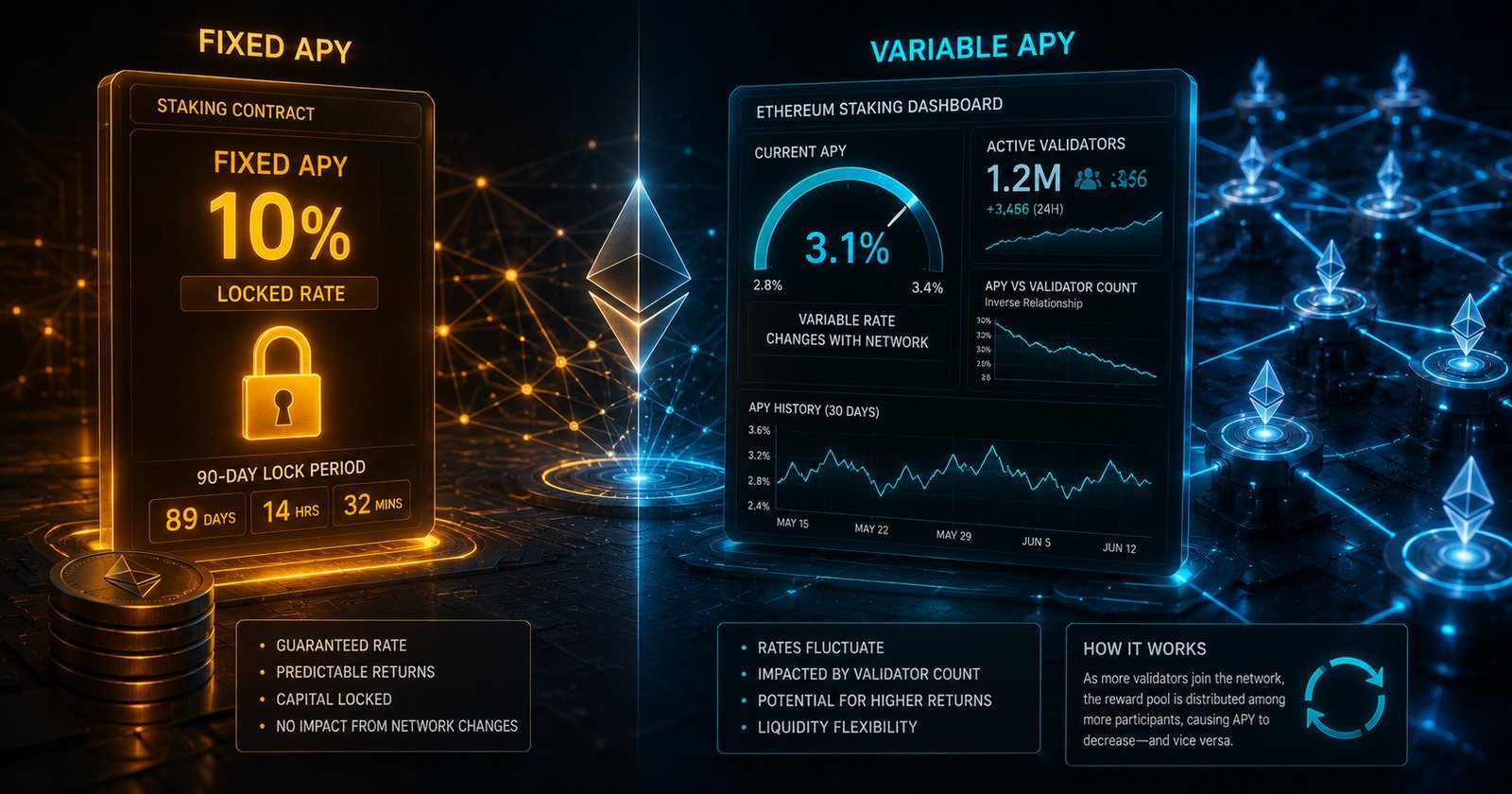
A fixed APY stays the same for a set period, often used by exchanges running a promotional or locked-term offer. A variable APY changes based on network conditions, and it’s the more common structure for proof-of-stake reward rates like Ethereum’s. According to Ethereum’s own protocol documentation, the reward each validator earns is inversely tied to the total number of active validators on the network.
Key Takeaway: Fixed APY offers short-term certainty. Variable APY moves with real network activity. Neither one is inherently safer — they just carry different kinds of trade-offs.
Why Variable Rates Move the Way They Do
More people staking a network usually means each individual staker earns a smaller slice of the total reward pool. This is by design, since the protocol only needs to pay enough to keep the network secure. Fewer stakers, higher individual rewards. More stakers, lower individual rewards.
Ethereum as a Real Example
Ethereum’s staking yield has compressed over time as more ETH joined the validator set. What paid over 4% APY in earlier years has settled closer to 3% as participation grew, and it can shift further as the total staked amount changes. This is a textbook case of how crypto staking rate fluctuations work in practice.
Data Point: Ethereum’s protocol-level reward rate scales inversely with the total number of active validators — as more ETH gets staked network-wide, the per-validator share of issuance shrinks, and vice versa.
Planning Around a Moving APY
Locking into a fixed-rate promotion can feel safer, but it usually comes with a catch: a minimum term, a withdrawal penalty, or a rate that resets lower once the promotion ends. Variable rates carry more short-term uncertainty, but they usually reflect real network economics rather than a temporary marketing offer.
| Type | Predictability | Typical Trade-Off |
|---|---|---|
| Fixed APY | High for the term | Often locked funds, promo rate resets after term |
| Variable APY | Moves with network activity | No lock-in, but reward changes week to week |
Risk Note: Staking carries risk beyond rate changes, including slashing penalties, lock-up periods, and protocol-level risk. Estimated or historical APY figures are not a guarantee of future returns.
Before committing to either, it helps to model both scenarios with your actual stake size and time horizon rather than relying on the headline rate alone.
The Bottom Line
Neither fixed nor variable staking APY is automatically better. Fixed rates offer short-term certainty at the cost of flexibility, while variable rates track real network conditions but require more attention over time.