How to Calculate Your Real Staking Yield After the Token Price Drops
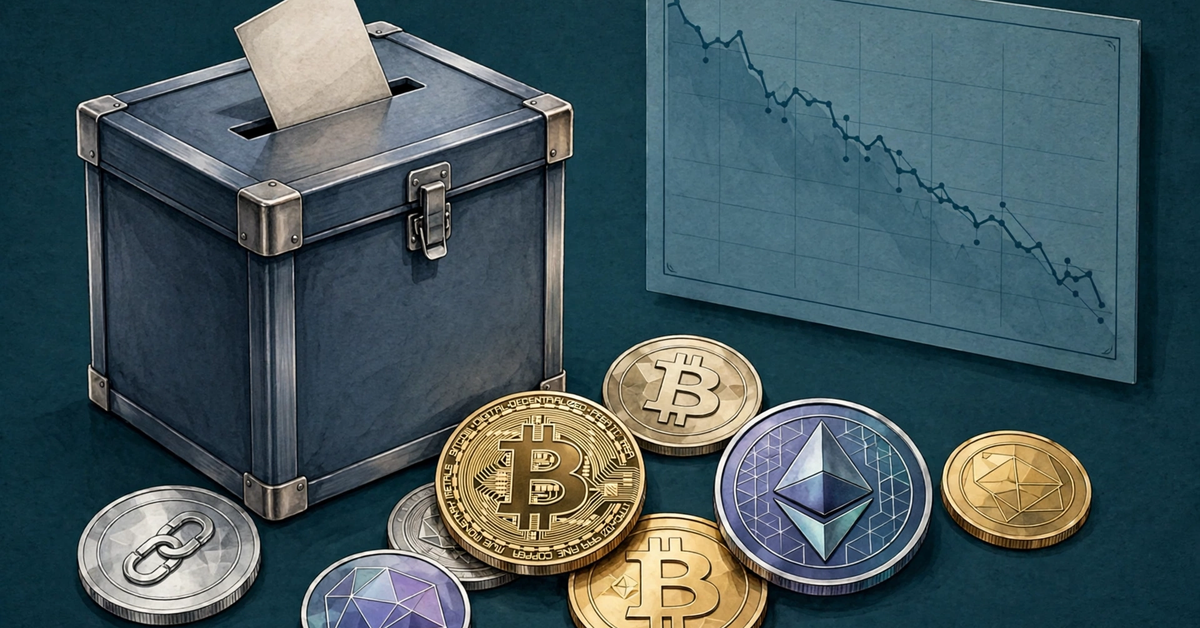
Your staking dashboard says you earned 10% APY this year. Your wallet says you are down 23%. Both numbers are true — and that is exactly the trap. Staking rewards are denominated in tokens, not dollars. When the token's price falls, your "gains" can shrink, vanish, or even turn negative in the currency you actually spend.
Most stakers only track one number: the reward rate. Serious stakers track two: the token-denominated yield and the price-adjusted yield in fiat terms. Here is how to calculate the second one, and why it changes which coins are actually worth staking.
The Core Problem: APY Measures Tokens, Not Money
When a chain advertises 10% APY, it means you will end the year holding roughly 10% more tokens than you started with (a bit more with compounding). It says nothing about what those tokens will be worth. A 10% APY on a token that fell 40% leaves you deep underwater. A 4% APY on a token that rose 60% made you a fortune. The headline rate is only half the story.
This is different from validator commissions and lock-up mechanics, which cut your token rewards — validator commission fees show exactly how much those take. Price movement cuts your dollar rewards, and it is usually the bigger factor of the two.
A Worked Example: 10% APY That Lost You Money
Say you stake 1,000 tokens at $1.00 each — a $1,000 position. The chain pays 10% APY, compounded annually, so after one year you hold 1,100 tokens. But the token price has dropped to $0.70.
Your USD value is now 1,100 × $0.70 = $770. You started with $1,000 and ended with $770 — a -23% return despite "earning" 10%. Without staking, you would have held $700; staking rescued $70 of the loss, but the position still lost money. The general formula is:
Real yield = (1 + APY) × (P1 / P0) − 1
Where P0 is the price when you staked and P1 is the price now. Plug in the example: 1.10 × (0.70 / 1.00) − 1 = 1.10 × 0.70 − 1 = −23%. Flip the scenario — token rises to $1.50 — and the same 10% APY becomes 1.10 × 1.50 − 1 = +65%. The APY was identical in both cases. The price did all the work.
Key takeaway: Always calculate your staking return in two units — tokens (did my balance grow?) and dollars (did my purchasing power grow?) — because a falling token price can erase any APY.
Adjusting for Inflation: The Third Number
On many proof-of-stake chains, rewards are paid out of new token issuance — inflation. If a chain has 10% staking rewards and 7% annual token inflation, the real token yield is closer to 3%, because the supply you own a slice of is expanding underneath you. The non-stakers' dilution is your gain, but only net of the inflation itself.
Rule of thumb: inflation-adjusted real yield ≈ nominal APY − token inflation rate. A chain paying 15% APY with 12% inflation is really paying about 3% in token terms — before price moves. Compare coins on this number, not the headline APY. Check a coin's emission schedule on its official docs or a data site like CoinGecko before locking up funds, and understand how APR and APY differ with compounding so the rate you plug in is the right one.
When staking through a price drop still makes sense
There are legitimate reasons to keep staking while the price falls. If you are accumulating for the long term and believe the token will recover, staking compounds your position in token terms — you will own more tokens for the eventual rebound. It also beats sitting in an unstacked wallet earning nothing. But do it with eyes open: the staking rewards are a cushion, not a guarantee.
Key takeaway: Compare staking opportunities on inflation-adjusted, price-adjusted yield — a 6% APY on a stable, low-inflation token often beats a 20% APY on a fast-depreciating one.
Plug your own numbers into the Crypto Staking Calculator to see your projected token rewards — then adjust for the token's price trend to find your real yield.
Conclusion
A staking APY is a promise denominated in tokens, and tokens are not dollars. Run the real-yield formula — (1 + APY) × (P1/P0) − 1 — on every position, subtract inflation on high-emission chains, and judge each coin by what it does to your actual wealth, not by the headline rate on the dashboard. The best staking strategy is the one that grows your money in the currency you live in.
Disclaimer: This article is for educational purposes only and is not financial advice. Staking involves risks including slashing, lock-up periods, and price volatility. Do your own research before staking any asset.