Staking Yield Curves Explained: Why Early Stakers Often Earn More
A validator who staked Ethereum in its first year earned a noticeably higher rate than someone staking the same amount today. That’s not luck — it’s the staking yield curve at work. Understanding how this curve behaves helps you set realistic expectations before you lock up any coins.
What a Staking Yield Curve Actually Shows
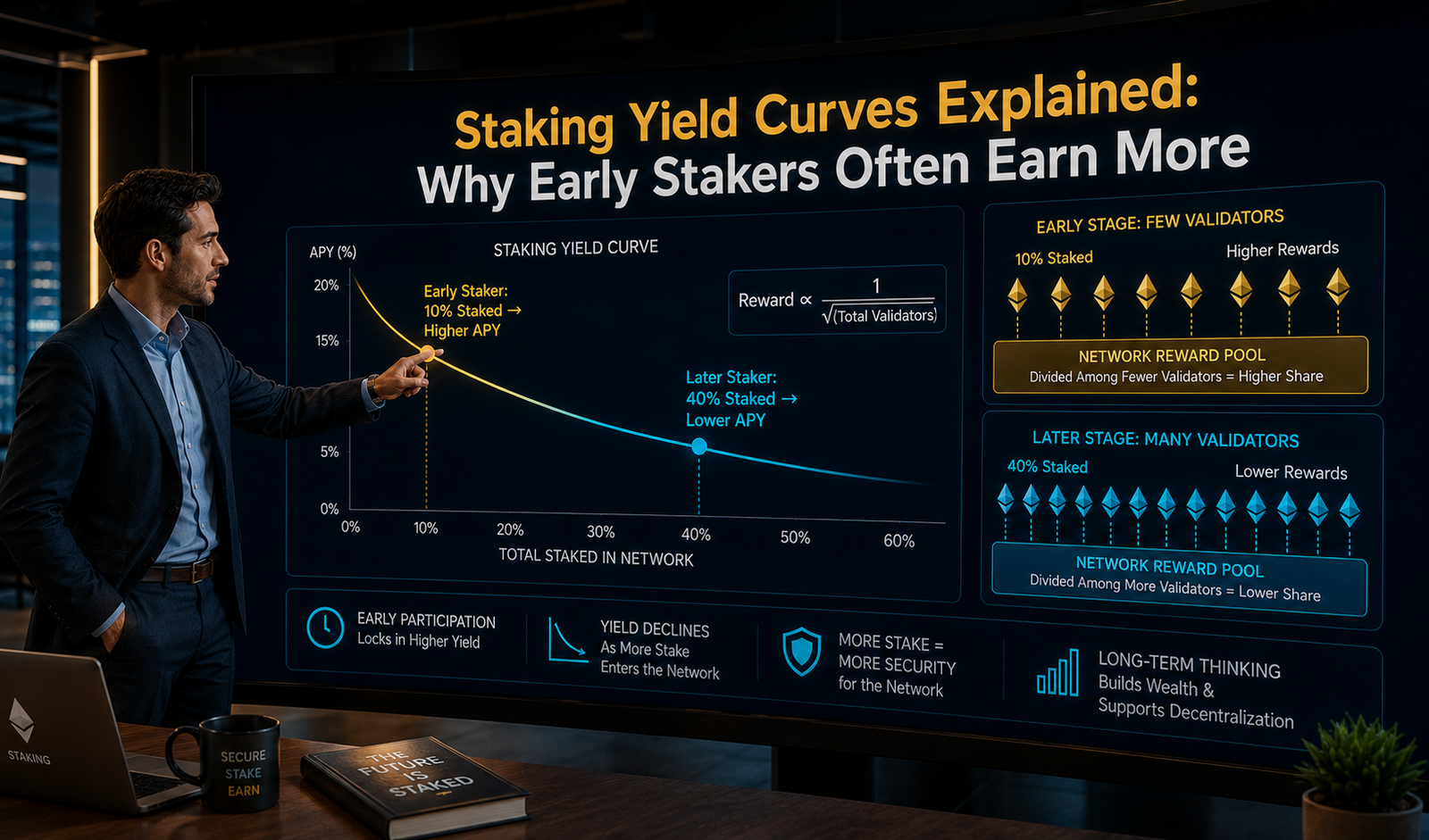
A staking yield curve maps how reward rates change as more of a network’s supply gets staked. On proof-of-stake networks like ETH, the reward pool is shared across all active validators, so Ethereum’s own developer documentation explains that each validator’s individual reward shrinks roughly in proportion to the square root of the total number of validators. More participants, smaller slice each.
Per Ethereum’s protocol documentation, individual validator rewards scale inversely with the square root of the total validator count — a mathematical, not incidental, relationship.
Why Early Stakers Often Earn More
When a network launches or first enables staking, few people have joined yet, so the reward pool is split fewer ways. As adoption grows and more coins get staked, that same pool stretches thinner across a larger validator set. This isn’t a bug or a marketing trick — it’s how most proof-of-stake reward formulas are designed to work.
Locked vs. Flexible Staking and Timing
Locked staking often pays a higher estimated rate than flexible staking because you’re committing your coins for a set period, which the network rewards for reduced liquidity risk. Timing matters too: joining early in a network’s staking lifecycle, before participation ramps up, has historically meant claiming a larger share of a smaller pool.
Early stakers don’t earn more because they predicted anything — they simply joined before the reward pool had to stretch across as many validators.
How the Staking Yield Curve Plays Out in Practice
Picture two stakers on the same network. One joins when 10% of supply is staked; the other joins once 40% is staked. The first staker’s rewards get divided among far fewer participants, so their estimated APY runs higher — even though both are staking the identical amount of coins. Neither outcome is guaranteed going forward, since reward rates shift as participation changes.
| Staker | Network Participation at Entry | Reward Pool Split |
|---|---|---|
| Staker A | 10% of supply staked | Fewer validators sharing rewards |
| Staker B | 40% of supply staked | More validators sharing rewards |
Higher estimated rewards for early stakers reflect current network conditions, not a promise. Reward rates can keep compressing as participation grows, and staking still carries price and protocol risk.
The Bottom Line
The staking yield curve explains a pattern seen across nearly every proof-of-stake network: rewards compress as more people join. Early stakers often earn more not because they timed the market perfectly, but because they entered when fewer validators were splitting the same pool. Estimated rates today reflect current participation, not a promise of what’s next.


